
6 State-of-the-Art Modern Forecasting Techniques
21st Century Supply Chain Planning: Empowering Manufacturers - Dr. Valeriy Manokhin - Forecasting Techniques


The following is an excerpt from Quantics' webinar series "21st Century Supply Chain Planning: Empowering Manufacturers”. In this episode, Dr. Valeriy Manokhin shared his thoughts and insights with us on leveraging advanced data analytics and AI in supply chain.
For a long time, since approximately the late 70s/early 80s, the paradigm was always ‘simple methods always perform better’, but this is no longer valid. In 2020 it all changed.
There are a lot of things one can do with Artificial Intelligence (AI) and Machine Learning (ML), but how does it translate to what manufacturers and companies are interested in?
Supply chain leaders know that current methods need to change from current solutions to using solutions containing advanced technologies such as AI and ML; 4 out of 5 companies expect or already do so (McKinsey & Company).
Dr. Valeriy Manokhin, a seasoned data science leader, says that if we analyze the emerging solutions we see the following state-of-the-art modern forecasting techniques come to the fore:
- Hierarchical forecasting
- Advanced time-series decomposition techniques
- Ensemble forecasting
- Probabilistic forecasting
- Hybrid forecasting
- Global vs local methods
Let's take a deeper dive into what these techniques are and how they can help companies gain a competitive edge.
1. Hierarchical forecasting
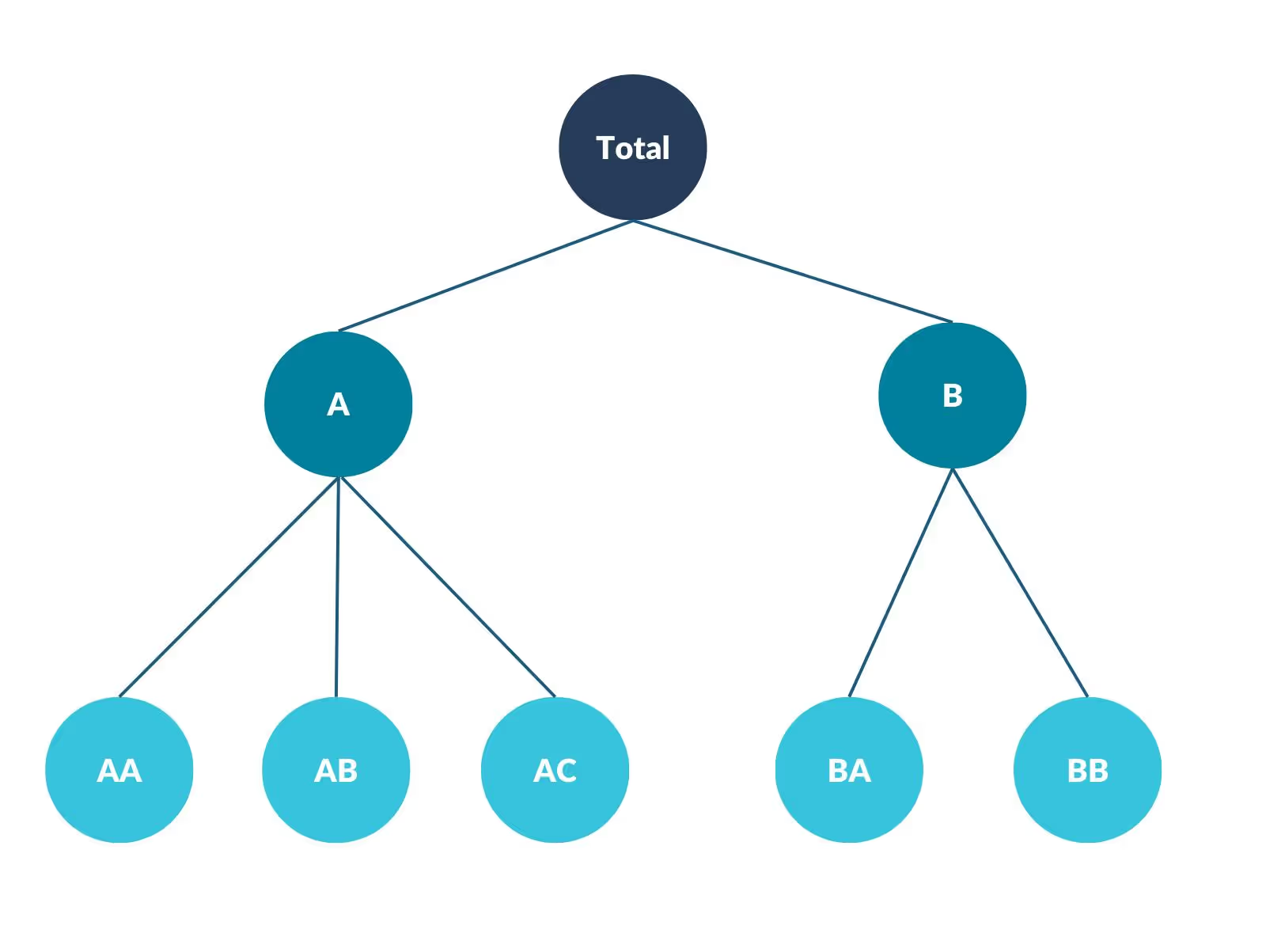
Imagine we are doing forecasts and we have some sort of hierarchy. For example, we have manufacturing plants A and B with several products produced, then we have the total sales for the company at the top. Of course we can try to forecast them separately, but then there is no guarantee that the sum of the sales of the two plants would coincide with the total sales.
Hierarchical forecasting improves the accuracy and consistency of predictions by leveraging the hierarchical structure that exists in data. The data can be organized into hierarchical levels using geographical regions, product categories or customer segments. This technique includes generating forecasting at different levels and reconciling them to obtain coherent and accurate predictions across all levels.
Key benefits include: Improved performance and a more comprehensive view of the data.
2. Advanced time-series decomposition techniques
In traditional forecasting, we often try to understand if a product has a trend, a seasonality. Until recently, it has been difficult to understand more complicated demand structures. If a product has multiple seasonalities, it has certain seasonalities during a year and, for example, during each month. That’s 2-3 seasonalities. It is only more recently that we have models that can analyze these seasonalities.
Advanced decomposition algorithms can be used for a better understanding of demand patterns as well as the detection of multiple seasonalities and trends for superior modeling and forecasting.
Key benefits include: Better insights into demand patterns, computationally efficient models, and the detection of multiple seasonalities.
3. Ensemble forecasting
The key idea here is by combining multiple models we can usually improve forecasting performance under certain conditions. Ensemble forecasting averages or combines predictions of several models in some way, the resulting forecast often being more accurate and robust than any single model’s forecast. This works best when the models being combined are diverse and not similar to one another.
Key benefits include: Improved accuracy, reduction in uncertainty, robustness and stability, and creates diversity in the forecast via the different models.
Machine Learning (ML) can incorporate less structured data. If you have new product sales, you have no sales history, but there may be similar products with similar attributes. You can tell the ML model what the new features of the product are and it will help build a forecasting model.
4. Probabilistic forecasting
This is becoming a very popular topic. Companies are interested in producing a range of outcomes to see what the variation is in the entire forecast, not just the mean. This is helpful in inventory planning and downstream decisions, for example, what the minimum stock level should be. Probabilistic forecasting estimates a range of potential outcomes and the probability associated with each outcome.
Key benefits include: Better inventory planning, better decisions and scenario planning.
5. Hybrid forecasting
Hybrid forecasting uses the same idea as Ensemble forecasting, it combines models, but here it’s combining classical time-series methods with Machine Learning techniques for more effective forecasting of demand, inventory optimization and promotions.
Key benefits include: Improved accuracy and forecasting performance, works for smaller datasets, and can handle both linear patterns (with traditional methods) and nonlinear patterns (with Machine Learning techniques).
6. Global vs local methods
Companies have a multitude of SKUs, so how do we use this information better? By forecasting multiple series at a time to improve forecasting performance by learning predictive signals across multiple time series and SKUs. Classical methods cannot handle global forecasts, but Machine Learning techniques can.
Key benefits include: Improved accuracy and forecasting performance, cross-learning of predictive signals across multiple time series, and a better understanding of demand patterns across product groups, for example.
The competitive advantage for manufacturers is all about making things better, on-time and cheaper. When planning into the future, what do we want to have?
How do the benefits of these techniques translate into dollars?
Aside from the various issues associated with traditional forecasting, some companies are seeing as low as 40%-50% accuracy rates, which is leaving a lot of money on the table.
A 15% forecast accuracy improvement (which is not out of reach for many companies) will deliver a 3% or higher pre-tax improvement, which could be a very large number. For a company that turns over $50 million, a 1% improvement in under-forecasting error generates savings of as much as $1.52 million (in over-forecasting, $1.28 million).* For a company with a $10bln turnover, a 1% forecasting accuracy improvement is worth $300 million.

* Source text and image: Institute of Business Forecasting & Planning
Want to learn more about this topic?
This is an excerpt from "Modern Forecasting for Manufacturers: Leveraging Advanced Data Analytics and AI in Supply Chain” with Dr. Valeriy Manokhin, on July 18th, 2023.
To watch the full episode, visit Quantics’ YouTube channel where we explore the transformative power of modern forecasting in today's dynamic manufacturing landscape with Dr. Valeriy Manokhin. This webinar presentation showcases how the key trends and recent advancements in AI and Machine Learning are revolutionizing traditional forecasting. Through practical insights, we'll illustrate key topics that are shaping the forecasting landscape. Learn how embracing modern forecasting can provide a competitive edge, propel profitability, and future-proof your manufacturing operations.
Meet Our Expert: Dr. Valeriy Manokhin
Dr. Manokhin is a seasoned data science leader, esteemed author, and researcher with a specialisation in Probabilistic Prediction as part of his PhD in Machine Learning.
He has an impressive academic background, boasting MSc degrees from University College London in Computational Statistics and Machine Learning, University of Sussex in Quantitative Finance and an MBA from the University of Warwick.
As a prolific scholar, Dr. Manokhin has contributed to various leading machine learning and industry journals, including 'Neurocomputing,' 'Journal of Machine Learning Research,' 'Machine Learning Journal,' and 'Frontiers in Energy Research.'
Dr. Manokhin's rich industry experience involves delivering substantial business value for large multinational corporations and consulting clients. He has a notable record of developing and launching AI-driven solutions for global companies, including implementing effective programs for over 130 manufacturing locations worldwide, quickly generating multimillion-dollar savings.
Dr. Manokhin is a thought leader in several key technical areas such as time series, forecasting and probabilistic and conformal prediction. His proficiency in forecasting is demonstrated by his track record of creating forecasting systems for Fortune 500 manufacturers and retailers.
Beyond his professional accomplishments, he is also the author of the book, 'Practical Guide to Applied Conformal Prediction: Learn and apply the best uncertainty frameworks to your industry applications.'

FAQ
1. What's the difference between ensemble forecasting and hybrid forecasting?
Ensemble forecasting combines predictions from multiple models to produce a final forecast, often by averaging them or assigning different weights to each prediction. The underlying models can be statistical, machine-learning-based, or a mixture of both. Hybrid forecasting goes a step further by integrating different modeling approaches, such as traditional time-series methods and machine learning, so their complementary strengths can be used within the forecasting process. Both approaches reduce reliance on a single model, which is also why Quantics' forecasting engine combines many forecasting methods rather than depending on one technique.
2. Do you need machine learning to do probabilistic forecasting?
No. Probabilistic forecasting can be done with classical statistical methods as well as machine learning. Instead of producing only a single point forecast, probabilistic forecasting estimates a range or distribution of possible future outcomes and their associated uncertainty. Many traditional time-series models can already generate prediction intervals or full probability distributions. Machine learning can add value for complex datasets and relationships, but it isn't a requirement for probabilistic forecasting.
3. What's the difference between global and local forecasting models?
A local forecasting approach fits a separate model to each individual time series, such as each product or SKU. A global model is trained across multiple time series at once, allowing it to learn patterns and relationships that are shared across products. This can be particularly valuable when individual series contain limited data, because the model can learn from information elsewhere in the portfolio. Traditional forecasting approaches are commonly applied locally, while many modern machine-learning and deep-learning methods are well suited to global forecasting.
4. Do you need thousands of SKUs to benefit from global forecasting methods?
No. There is no fixed number of SKUs required before global forecasting becomes useful. What matters is whether there is enough relevant information across the collection of time series for the model to learn patterns that generalize between them. Global models can therefore be useful for smaller portfolios when products share meaningful characteristics or demand patterns, while simply having thousands of unrelated series doesn't guarantee better results. Their effectiveness depends on factors such as the amount of available data, relationships between series, forecast horizon, and model design.
5. Are complex forecasting methods always more accurate than simple ones?
No. More sophisticated forecasting methods aren't automatically more accurate, and simple statistical models remain strong benchmarks for many forecasting problems. However, large forecasting competitions such as M4 and M5 have demonstrated that well-designed hybrid, ensemble, and machine-learning approaches can outperform traditional methods in certain settings, particularly when many related time series and useful explanatory variables are available. The lesson isn't to replace simple models with complex ones by default, but to evaluate multiple approaches against the actual data and use the method - or combination of methods - that performs best for the forecasting problem at hand.
Start now
Start now
Learn how Quantics leverages all the above mentioned state-of-the art forecasting techniques in its solutions, plus contains unique features that can optimally support your manufacturing businesses in unlocking the power of cutting-edge forecasting and supply chain planning.
Learn how Quantics contains unique features that can optimally support your manufacturing businesses in unlocking the power of cutting-edge forecasting and supply chain planning.

Frequently Asked Questions
Find answers to common questions about our solutions and how they benefit your operations.
.png)